Casting the Future: AI-Driven Quality Control in 2026
The metal casting industry is undergoing its most significant transformation in generations. Artificial intelligence is no longer a futuristic concept reserved for tech companies — it is actively reshaping how foundries detect defects, optimize processes, and deliver consistent quality at scale. From real-time anomaly detection to digital twins that simulate entire pours before a single ounce of metal is melted,
the smart foundry is here. This presentation explores how AI is redefining every stage of the casting quality control pipeline in 2026 and why the window to act is now.
Foundry Economics
The Hidden Cost of "Traditional" Casting
For decades, scrap rates have quietly eroded foundry margins — a persistent drag that many operations have accepted as an unavoidable cost of doing business. In reality, this acceptance creates a strategic liability. Traditional quality control is reactive, identifying defects only after resources, energy, and production time have already been consumed.
01
The Scrap Rate Problem
AI-driven optimization can reduce scrap rates by 15–30%, yet many foundries still depend on post-production inspection as their primary quality control strategy.
02
The "Wait and See" Trap
Traditional processes discover defects after production. Engineers react to failures rather than preventing them, resulting in recurring waste and inefficiency.
03
Hidden Resource Losses
Energy spent remelting scrap, excess labor, machine utilization, and finishing operations create significant but often overlooked costs.
04
Competitive Disadvantage
Yield variability disrupts deliveries, increases costs, and leaves traditional foundries struggling against AI-enabled competitors.
The Real Margin Leak
Scrap and rework costs in traditional foundries can consume 5–15% of annual revenue. AI-driven quality control shifts the focus from defect detection to defect prevention, helping manufacturers recover lost margins, improve yield consistency, and strengthen long-term competitiveness.
AI Quality Control
The Intelligence Shift: Proactive vs. Reactive
The most fundamental change AI brings to casting quality control is not a new sensor or a faster camera — it is a complete inversion of the decision-making timeline. Traditional foundry management is backward-looking by nature, while AI-driven management continuously predicts and prevents quality issues before they occur.
OLD
Traditional: Reactive Control
Defects are discovered after production through inspection, testing, or customer feedback. Engineers then adjust parameters manually, relying heavily on experience and trial-and-error.
- Defects identified after cooling
- Adjustments based on intuition
- High variability between shifts
- Knowledge locked in individuals
AI
AI-Driven: Proactive Control
Machine learning continuously analyzes process variables in real time, identifying defect patterns early and recommending corrective actions before defects form.
- Real-time process monitoring
- Predictive quality alerts
- Automated parameter recommendations
- Consistent quality across shifts
The New Quality Cycle
Detect
Find defects after cooling
→
Predict
Analyze real-time parameters
→
Prevent
Auto-adjust before defects form
A Different Operating Philosophy
This shift from reactive to proactive control represents a fundamentally different way of managing casting quality. Instead of treating quality as an outcome measured after production, AI treats quality as a controllable process input — continuously monitored, predicted, and optimized before defects ever have a chance to occur.
Quality Intelligence Evolution
From Manual Guesswork to Predictive Precision
The contrast between traditional and AI-driven inspection environments is striking. While conventional inspection relies on human judgment and post-production analysis, modern digital twin platforms provide continuous visibility into casting quality throughout the entire manufacturing process.
OLD
The Manual Inspection Reality
Traditional inspection depends on human observation, manual measurements, and post-process testing. While effective for basic quality checks, it struggles to maintain consistency and scale in high-volume production environments.
Throughput limited by human capacity
Inconsistency between shifts and inspectors
Sub-surface defects difficult to detect
Documentation and traceability gaps
AI
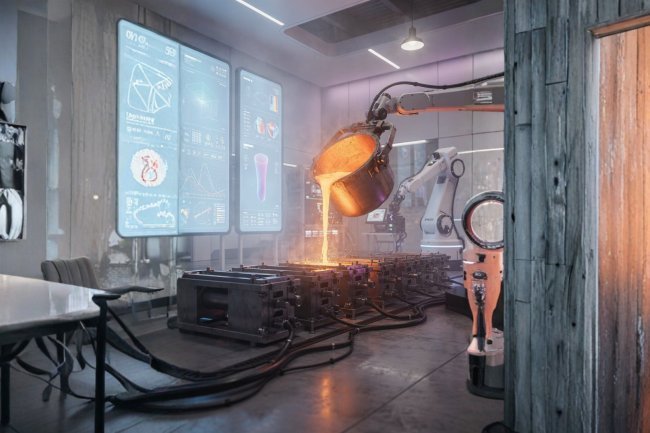
The Digital Twin Interface
AI-powered digital twins create a real-time virtual representation of the foundry process, integrating sensor data, simulation models, and predictive analytics into a single decision-making platform.
360° visibility into process parameters
Defect probability updated in real time
Complete digital audit trail for every casting
Virtual testing before live implementation
The Competitive Difference
Manual inspection focuses on finding defects after they occur. Digital twin platforms focus on predicting and preventing them before they happen. The result is higher throughput, improved consistency, stronger traceability, and a quality management system that scales with production rather than being constrained by it.
AI Inspection Systems
Automated Inspection: Seeing the Unseen
Vision-based AI inspection systems have reached a level of maturity that makes them superior to manual inspection across speed, consistency, and traceability. Combining deep learning, industrial imaging, and edge computing, these platforms identify defects with unprecedented precision while operating continuously at production scale.
AI
Surface Defect Detection
Deep-learning vision systems identify porosity, cold shuts, misruns, and shrinkage defects across complex casting geometries with remarkable consistency.
65.8%
Surface Detection Accuracy
CT
Internal Defect Identification
AI-enhanced CT and X-ray analysis detects sub-surface porosity, inclusions, and micro-cracks invisible to conventional visual inspection methods.
100%
Benchmark Internal Detection
BOT
Autonomous Decision Routing
Intelligent systems automatically classify, route, and document every casting while continuously improving through closed-loop learning.
220ms
Maximum Inspection Latency
Beyond Detection: Continuous Learning
Modern inspection platforms do more than identify defects. Every inspection result is linked to process conditions, defect signatures, and production outcomes, creating a continuously expanding dataset that improves model accuracy over time. The result is a self-optimizing quality system that becomes more effective with every casting produced.
Smart Foundry Infrastructure
Data as the Ultimate Raw Material
In a smart foundry, data is no longer a byproduct of production — it is the foundation that powers AI, automation, and continuous optimization. The quality and connectivity of a foundry's data infrastructure ultimately determine the effectiveness of every predictive model and decision-making system.
01
Breaking Down the Silos
The biggest barrier to AI adoption is often fragmented data. Modern Industry 4.0 platforms unify machine, production, and quality information into a single data ecosystem that AI can access in real time.
IIoT gateways connect legacy and modern equipment
ERP and MES systems share production intelligence
Scalable cloud and edge data storage
Standardized APIs for seamless AI integration
02
Digital Twins: Simulate Before You Pour
Digital twin platforms transform integrated production data into a living simulation model, allowing engineers to test process changes virtually before they reach the foundry floor.
Simulate filling dynamics and solidification
Predict shrinkage, porosity, and thermal stress
Optimize gating and riser configurations virtually
Accelerate new alloy and part qualification
30–50%
Faster Root Cause Analysis
Foundries that implement unified IIoT data platforms can dramatically accelerate defect investigations because every relevant process parameter, quality outcome, and production event is instantly accessible, correlated, and traceable from a single source of truth.
Proven Industry Results
Success in Action: Global Foundry Results
The business case for AI-driven quality control is no longer theoretical. Leading foundries across multiple continents and casting processes have documented measurable gains in scrap reduction, energy efficiency, and production yield — validating AI as a practical manufacturing advantage rather than an experimental technology.
40%
40% Scrap Reduction
Foundries including Huaxiang, Condals, and MAT Group achieved significant reductions in scrap rates after deploying AI-driven process optimization systems trained on historical production and quality data.
Validated across multiple continents
Applied to automotive, aluminum, and sand casting
Real-time parameter optimization improved consistency
ROI
Energy + Yield Breakthrough
Adaptive machine learning systems demonstrated the ability to simultaneously reduce energy consumption and improve production yield — a combination that directly strengthens foundry profitability.
17% reduction in energy consumption
3.8% improvement in production yield
Approximately 8–12% per-part economic improvement
40%
Average Scrap Reduction
From Pilot Projects to Proven Business Outcomes
These results reflect a growing body of evidence from hundreds of AI-enabled foundry deployments worldwide. As implementation methodologies mature and data infrastructure improves, AI-driven quality improvements are becoming increasingly predictable, repeatable, and financially justifiable — transforming AI from a competitive advantage into an operational necessity.
Workforce Transformation
Bridging the Skills Gap
As experienced foundry professionals retire, AI is becoming a powerful mechanism for preserving institutional knowledge and accelerating workforce development. Rather than replacing expertise, modern AI systems capture, distribute, and amplify it across the entire organization.
XAI
Explainable AI as a Knowledge Repository
Modern Explainable AI platforms do more than generate recommendations. They document the reasoning behind every decision, transforming decades of foundry expertise into a searchable, continuously evolving knowledge system.
Explains why process adjustments are recommended
Captures expert decision-making logic permanently
Creates a real-time learning environment for engineers
45%
Faster Engineer Onboarding
AI
Operator Empowerment, Not Replacement
Leading foundries use AI to augment operator performance, not eliminate it. By automating routine monitoring and analysis, teams can focus on process improvement, innovation, and exception management.
Operators focus on optimization and problem-solving
AI manages continuous parameter monitoring
New digital engineering and AI support roles emerge
68%
Lower Decision Variability
85%
Operator Satisfaction
Technology + Change Management = Success
Foundries that combine AI deployment with structured workforce engagement programs consistently achieve higher adoption rates and stronger business outcomes. The most successful implementations position AI as a partner to skilled operators, preserving expertise while making it accessible across the entire organization.
Business Impact & ROI
The ROI of Smart Foundries
AI-driven quality control has evolved from an experimental technology into a proven business investment. With documented deployments across global foundries, organizations can now model returns with confidence, combining operational efficiency, sustainability gains, and long-term competitive advantage.
01
Weeks 1–8
Pilot Deployment
Assess data infrastructure, install IIoT sensors, ingest historical production data, train AI models, validate predictions, and begin workforce onboarding.
02
Months 3–6
Line Expansion
Expand deployment to additional production lines, integrate ERP and MES platforms, and establish digital twin capabilities for process simulation.
03
Months 6–9
Full-Scale Implementation
Complete plant-wide rollout, automate inspection workflows, establish digital traceability, and implement continuous AI model retraining.
ROI
Month 12+
Compounding Returns
Models improve with every production cycle, delivering growing gains in quality, efficiency, sustainability, and customer satisfaction.
Sustainability as a Financial Benefit
Reduced scrap rates mean fewer remelting cycles, lower energy consumption, and reduced carbon intensity. As sustainability requirements become increasingly important to customers and regulators, these operational improvements create measurable financial value while strengthening environmental performance.
12–18
Months Typical ROI Payback Period
Typical Value Creation Summary
15–40%
Scrap Cost Reduction
20–35%
Rework Labor Savings
5–17%
Energy Cost Reduction
40–60%
Inspection Cost Reduction
50–80%
Fewer Customer Claims
New Business
Access to Aerospace & Medical Markets
The Future of Foundries
The 2026 Mandate: Adapt or Stagnate
AI-driven quality control has moved beyond experimentation. In 2026, the competitive advantage belongs to foundries that can predict, prevent, and optimize quality outcomes in real time. The question is no longer whether to adopt AI — it is how quickly organizations can integrate it into their operations.
AI
AI Is the New Baseline
What was once a competitive advantage is rapidly becoming a supplier qualification requirement. Automotive, aerospace, and medical manufacturers increasingly expect AI-enabled quality systems as a standard capability.
0
The Path to Zero-Defect
Predictive process control, automated inspection, and digital twin simulation create a practical roadmap toward near-zero defect escape rates and consistently higher casting quality.
NOW
Your Next Pour Matters
Every production cycle without AI widens the competitive gap. With pilot programs capable of delivering measurable results within weeks, delaying adoption carries increasing operational and financial risk.
"The foundries that will lead in 2030 are making their AI investments today. The path to zero-defect manufacturing starts not with a strategy document — it starts with your next pour."
Your Next Steps
Assess Infrastructure
Audit sensor coverage, data connectivity, and ERP/MES integration readiness.
Define Pilot Metrics
Select a target production line and establish measurable quality and scrap reduction goals.
Launch First AI Pour
Deploy AI on a pilot line and begin generating the operational data that fuels long-term improvement.