Batch Simulation Strategies for Casting Process Optimization
A deep dive into how digital simulation, automated optimization engines, and high fidelity modeling are transforming the way foundries design, test, and manufacture precision metal castings — eliminating waste and accelerating time-to-market.
The Era of
Trial and Error
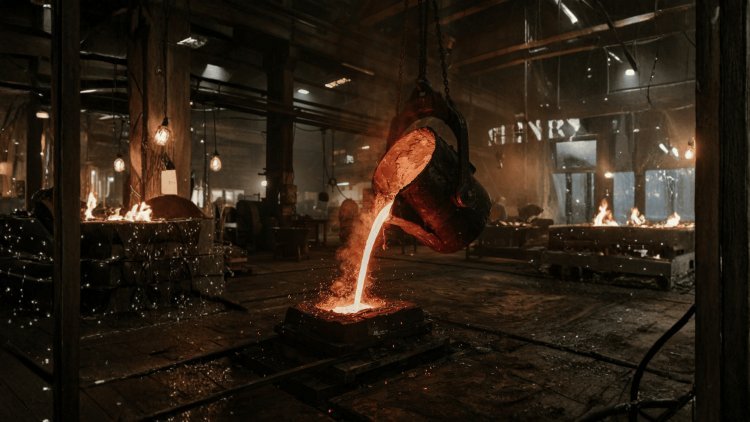
For decades, casting process development was dominated by an expensive and time-intensive cycle of physical experimentation. Engineers designed tooling, poured trial castings, inspected results, modified the design, and repeated the process until quality targets were achieved. While effective, this approach consumed significant resources and imposed severe limitations on innovation, efficiency, and manufacturing competitiveness.
Three Major Limitations of Trial-and-Error Development
The Hidden Cost of Physical Trials
Every shop-floor casting trial requires a complete material charge, furnace energy, mold preparation, operator labor, machining resources, and tooling utilization. Even a single unsuccessful experiment can consume thousands of dollars before the first production-quality casting is achieved.
Most casting programs require multiple development iterations. When five or more physical trials are needed before process convergence, direct expenses and schedule risks escalate rapidly.
What Every Physical Trial Consumes
The Compounding Cost Effect
Why Traditional Methods Fall Short
Conventional casting design relies heavily on heuristic rules, empirical relationships, and experience-based decision making. Riser formulas, gating ratios, and pouring temperature guidelines provide useful starting points, but often struggle to predict the complex interactions governing modern casting processes.
These methods treat casting largely as a geometric problem while overlooking the dynamic coupling between fluid flow, heat transfer, phase transformation, and solidification kinetics.
Critical Defects Traditional Methods Often Miss
Micro-Porosity
Shrinkage voids developing at the sub-millimeter scale due to localized solidification gradients.
Hot Spots
Thermally isolated regions that solidify last and accumulate shrinkage defects.
Misruns & Cold Shuts
Incomplete filling caused by insufficient temperature or metal velocity.
Oxide Inclusions
Non-metallic films entrained into the casting due to turbulent flow conditions.
Simulation technology has matured to the point where a skilled process engineer can predict, with high confidence, the location and severity of casting defects before a single gram of metal is melted.
FDM-based solvers compute the volumetric contraction that occurs as liquid metal transitions through mushy-zone solidification to fully solid state. By tracking isotherms through time, the software identifies which regions lack adequate liquid feeding — the precursor to shrinkage porosity.
One of the most powerful applications of casting simulation is the ability to virtually manipulate gating geometry, riser dimensions, and pouring parameters without modifying physical tooling.
Test whether a taller riser eliminates a hot spot.
Test whether a choked sprue reduces surface turbulence.
Test whether a lower temperature improves feeding efficiency.
Each configuration guides the next design iteration rationally rather than empirically.
The competitive advantage of simulation is fundamentally a time advantage. Where a physical trial cycle spanning pattern modification, melt preparation, pouring, cooling, and inspection might require five to fifteen working days, a simulation iteration completes in minutes to hours depending on mesh resolution and solver settings.
Casting process modeling compresses the development cycle while expanding the range of designs engineers can evaluate. By combining FDM-based solidification modeling with virtual gating, riser adjustment, and rapid simulation iterations, teams can move from empirical experimentation toward rational, evidence-based optimization.
The Power of
Casting Process ModelingFinite Difference
Solidification ModelingVirtual Gating
& Riser AdjustmentStrategic Time Compression
Explore What Physical Testing Cannot
Predict Defects.
Test Virtually.
Optimize Faster.
Integrated platforms like HyperOpt with SOLIDCast define a parameterized design space. Variables such as riser height, pouring temperature, and chill placement are systematically sampled using factorial sweeps, gradient methods, or evolutionary strategies. Each iteration runs autonomously, evaluating defect metrics against objective functions like minimizing shrinkage or maximizing yield.
An industrial batch optimization campaign began with a baseline yield of 48%. Over 100 automated cycles, riser dimensions and placement were systematically varied. The result: yield increased to 78% — a 30-point improvement. This translated into reduced raw material cost, lower energy consumption, and decreased post-processing burden from riser removal.
A 30-point yield improvement achieved through 100 automated cycles — with zero physical trials — demonstrates the economic power of integrated casting optimization.
Optimization Engines in Casting Simulation
How Optimization Engines Work
Design Variables Commonly Optimized
Case Study: Yield Improvement
As casting processes become increasingly sophisticated and quality requirements more demanding, simulation technology must evolve beyond simplified solidification models. Modern high-fidelity platforms capture the complete multi-physics environment of casting, simultaneously resolving fluid flow, heat transfer, solidification behavior, thermal cycling, and microstructural evolution. The result is a predictive capability that enables engineers to optimize performance, quality, and manufacturability before production begins.
Platforms such as STAR-Cast combine Computational Fluid Dynamics (CFD) with solidification kinetics models to predict mold filling behavior and thermal evolution simultaneously. Unlike simplified approaches, these simulations capture transient events throughout the casting cycle.
Engineers can observe how molten metal enters the cavity, interacts with mold geometry, exchanges heat, and develops the temperature gradients that ultimately govern defect formation and final quality.
Automotive and aerospace manufacturers increasingly require wall thicknesses below 3 mm to meet aggressive lightweighting targets. At these dimensions, solidification occurs extremely rapidly and process control becomes highly sensitive.
High-fidelity simulation accurately captures the short filling windows, rapid thermal extraction, and transient flow behavior that determine success in thin-section manufacturing.
At extreme wall thickness reductions, metal velocity, fill temperature, and die thermal conditions become decisive factors controlling casting quality.
Die casting tools continuously heat during filling and cooling phases and then cool during extraction, lubrication, and preparation for subsequent cycles. Predicting long-term behavior requires multiple successive thermal cycles rather than a single isolated simulation.
High-fidelity tools track transient thermal evolution until equilibrium is achieved, helping engineers design cooling systems that optimize quality while extending die life.
Mechanical performance is fundamentally controlled by microstructure, which itself is governed by local cooling conditions during solidification. Advanced platforms calculate Secondary Dendritic Arm Spacing (SDAS) using established metallurgical relationships linked to local cooling rates.
Engineers can predict whether specific regions of the casting will satisfy strength, fatigue, and elongation requirements before production begins.
Advanced High-Fidelity
SimulationFive Pillars of High-Fidelity Simulation
Multi-Scale Fluid & Thermal Modeling
Critical Phenomena Captured
Thin-Walled & Vacuum Die Casting
Ultra-Thin Structural Walls
Cyclic Thermal Stability Analysis
Thermal Cycle Behavior
Microstructural Precision: Dendritic Arm Spacing
The convergence of advanced simulation physics, automated optimization algorithms, and streamlined software workflows is fundamentally reshaping what is possible in casting process development.
Modern casting simulation platforms have invested significantly in user experience, bringing graphical setup wizards, template-based process configurations, and automated meshing to workflows that previously demanded months of specialist training.
Simulation-driven optimization creates two parallel value streams — and they reinforce each other.
Predicting and eliminating defects before production reduces scrap rates, rework costs, warranty claims, and the reputational damage caused by field failures.
Digital iterations replace physical trial cycles, allowing new casting designs to reach production readiness in a fraction of the calendar time.
Both value streams deliver measurable financial return and are not in tension. Simulation enables casting operations to improve quality and accelerate development simultaneously.
The foundries that will define the next decade of manufacturing excellence are those committing now to iterative, simulation-driven process development.
Begin with defect prediction for existing problematic castings.
Develop simulation capability through structured training and repeatable workflows.
Progressively integrate automated optimization into new product introductions.
Automated loops replacing physical shop-floor trials
Percentage-point improvement with zero physical trials required
Simulation iterations measured in hours vs. weeks
The Future of Optimized Manufacturing
Integrated Workflows &
Shorter Learning Curves
not years.From Setup to Ranked Decisions
Quality + Speed
Quality Improvement
Speed-to-Market
Minimize time-to-market.Adopt Iterative Simulation Today
Establish a Baseline
Build Internal Competency
Automate Optimization
The Compounding Effect
POINTS
What's Your Reaction?